
August is brought to you by the letter A
... No one knows why 'A' is the first letter of the alphabet.
Some think it's because this letter represents one of the most common vowel sounds in ancient languages of the western hemisphere. Other sources argue against this theory because there were no vowel sounds in the Phoenician language. (The Phoenician alphabet is generally thought to be the basis of the one we use today.
No one knows why the 'A' looks the way it does, but we can construct a fairly logical chain of events.
Some say the Phoenicians chose the head of an OX to represent the 'A' sound. (for the Phoenicians, this was actually a glottal stop). The ox was a common, important animal to the Phoenicians. It was their main power source for heavy work. Oxen plowed the fields, harvested crops and hauled food to the markets. Some sources also claim that the ox was often the main course at meals. A symbol for the ox would have been an important communication tool for the Phoenicians. It somewhat naturally follows that an ox symbol would be the first letter of the alphabet.
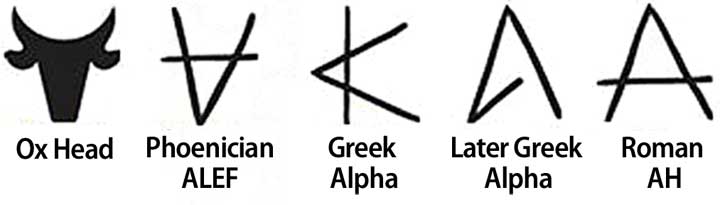
The Phoenicians first drew the ox head 'A' as a 'V' with a crossbar to distinguish the horns from the face. They called this letter "alif," the Phoenician word for ox. Through the centuries of writing (most of it quickly, with little care for maintaining detail) the alef evolved into a form that looked very different from the original ox head symbol. In fact, by the time it reached the Greeks in about 400 BC, it looked more like our modern 'K' than an "A".
The Greeks further changed the alef. First they rotated it 90 degrees so that it pointed up. Then they made the crossbar a sloping stroke. The Greeks also changed the letter name from alef to alpha. Finally they made the crossbar a horizontal stroke and the letter looked almost as it does today.
The Romans received the Greek alphabet by way of the Etruscan traders of what is now norther Italy. While Romans kept the design, they changed the name of the first letter -- this time to "ah." The sound "ay," or the name for the 'A,' was not common to the Latin language.
The Roman capital letters have endured as the standard of proportion and dignity for almost 2,000 years. They're also the basis of many of the lowercase designs. 'A' is the first letter. There are 25 more stories!
Thank you Allan Haley for this historic minute in typography history.
Allan Haley is a long time hero of the Design Center, and his expertise in typography and typographic design is second to none. His clients include Apple, Adobe, Linotype, and Monotype among others. Allan was executive vice president of ITC, and before that was in charge of typographic development at Agfa Monotype. He is highly regarded as an educator, and he is a frequently requested speaker. I met him through the Dynamic Graphics (DGEF) conferences series.
- Take a stroll through the trails of Allan Haley
- 497 Positive Words That Start with A
- Enjoy the 21 Best Songs About August beginning with Taylor Swift!
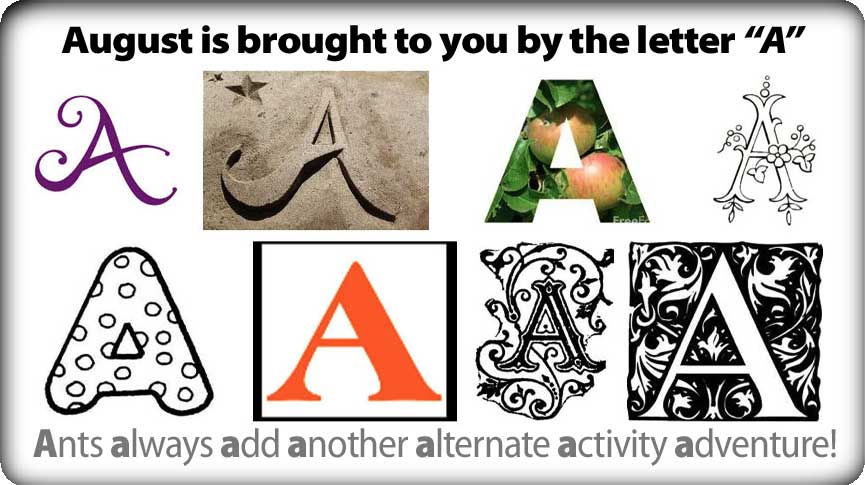
Please enjoy our “Letter A” poster for the month of August
Thanks for reading

Don't forget ... we encourage you to share your discoveries about favorite or famous graphic designers and illustrators with other readers. Please post your suggestions and comments at DT&G on Facebook for discussion, or give me a tweet at @DTG_Magazine
➤ DT&G ➤Facebook ➤ X ➤ Medium ➤ Quora
© 1993 60-Seconds.com © DT&G 1988–2026 · All rights reserved. DT&G Magazine, and is a spam-free, ad-free, tracker-free, script-free, predator-free, stalker-free web site. 60-Seconds is a member of, and supporter of SafeNetting SpamCop.net, SpamHaus.org and UGNN InfoManager. DT&G (Design, Typography & Graphics) is a reader-supported, independent online publication established in 1988. It has been published continuously through successive online platforms—including commercial online services, email distribution, and, since 1995, the World Wide Web. There are no terms of service, no cookies and we won't spam you. DT&G is not interested in your identity other than what you wish to share with us in terms of talent, creativity and discoveries. The content here is protected by copyright and many trademarks are the property of their perspective owners. But none of our web sites require anything from you whatsoever other than a smile, a like and a share if you're so inclined.
FAIR USE NOTICE: This web site may make use of copyrighted material. Such material are made available for commentary and educational purposes only. This constitutes a "Fair Use" of any such copyrighted material as provided for in TITLE 17 U.S.C. SECTION 106A-117 of the United States Copyright Law.
