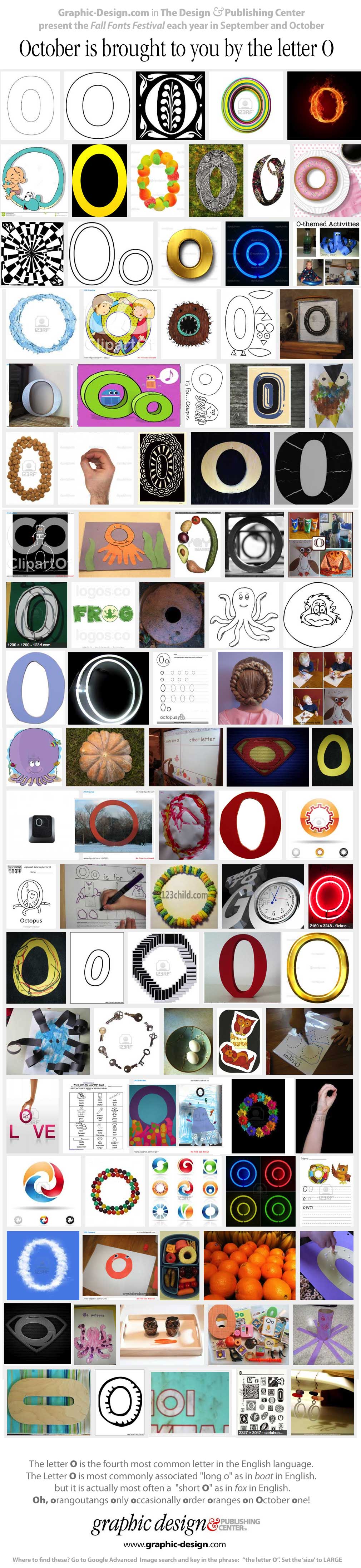
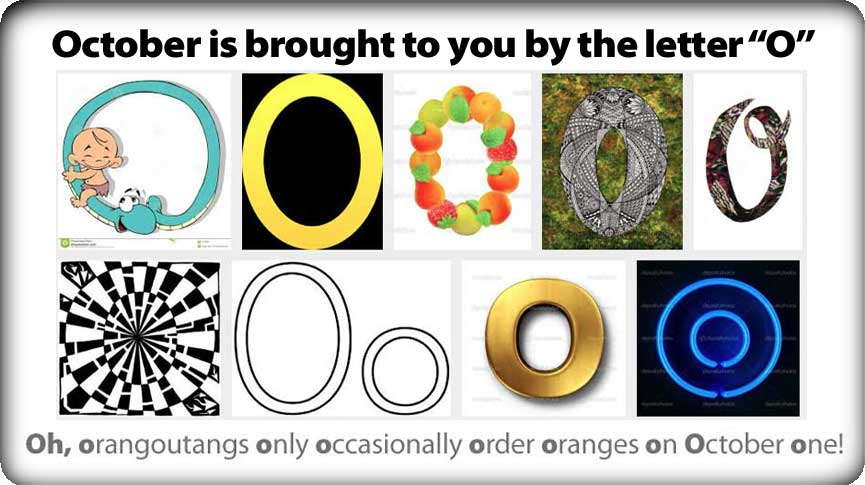
October is brought to you by the letter O
Some believe that our present O evolved from a Phoenician symbol; others vote for an even more ancient Egyptian heiroglyph as the source. 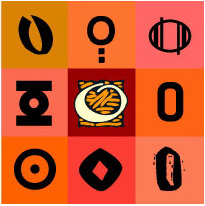 The most fanciful explanation, though, is offered by Rudyard Kipling in his Just So Stories. "How The Alphabet Was Made" recounts how a Neolithic tribesman and his precocious daughter invent the alphabet by drawing pictures to represent sounds. After finishing the A and Y (inspired by the mouth and tail of a carp), the child, Taffy, asks her father to make another sound that she can translate into a picture.
 'Now make another noise, daddy.'
'OH' said her Daddy, very loud.
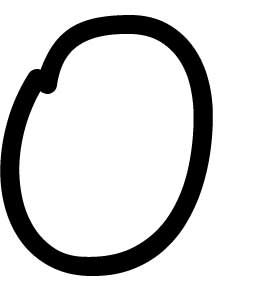
'That's quite easy,' said Taffy. 'You make your mouth all around like an egg or a stone. So an egg or a stone will do for 'You can't always find eggs or stones. We'll have to scratch a round something like this."
The father's sketch of the first O would serve perfectly well today, since round remains the defining property of the letter. Actually, the O did start out as a drawing of something, but not an egg or a stone , oreven a mouth. The true ancestor of our O was probably the symbol for an eye, complete with a center dot for the pupil. They symbol for eye, "ayin" (pronounced "eye-in") appears among the Phoenician and other Semitic languages around 1000 B.C.
The Greeks adapted the aryin to their communication system and used it to represent the short vowel sound of 'o.' The Greeks also changed the name of the letter to Omicron. (The Omega is another Greek O, which they invented to represent the long 'O' sound.)
While the Phoenicians and the Greeks drew the letter as a true, nearly perfect circle, the Romans condensed the shape slightly to be more in keeping with their monumental capitals.
Thank you Allan Haley for this historic minute in typography history.
Allan Haley is a long time hero of the Design Center, and his expertise in typography and typographic design is second to none. His clients include Apple, Adobe, Linotype, and Monotype among others. Allan was executive vice president of ITC, and before that was in charge of typographic development at Agfa Monotype. He is highly regarded as an educator, and he is a frequently requested speaker. I met him through the Dynamic Graphics (DGEF) conferences series.
- Take a stroll through the trails of Allan Haley
- Ten thousand Ohs from Google (you got to keep on scrolling!)
- 63 Positive Words That Start With the letter O
- Here's How to draw the Letter O!
Please enjoy our “Letter O” poster for October suitable for printing and framing!
Thanks for reading

Don't forget ... we encourage you to share your discoveries about favorite or famous graphic designers and illustrators with other readers. Please post your suggestions and comments at DT&G on Facebook for discussion, or give me a tweet at @DTG_Magazine
➤ DT&G ➤Facebook ➤ X ➤ Medium ➤ Quora
© 1993 60-Seconds.com © DT&G 1988–2026 · All rights reserved. DT&G Magazine, and is a spam-free, ad-free, tracker-free, script-free, predator-free, stalker-free web site. 60-Seconds is a member of, and supporter of SafeNetting SpamCop.net, SpamHaus.org and UGNN InfoManager. DT&G (Design, Typography & Graphics) is a reader-supported, independent online publication established in 1988. It has been published continuously through successive online platforms—including commercial online services, email distribution, and, since 1995, the World Wide Web. There are no terms of service, no cookies and we won't spam you. DT&G is not interested in your identity other than what you wish to share with us in terms of talent, creativity and discoveries. The content here is protected by copyright and many trademarks are the property of their perspective owners. But none of our web sites require anything from you whatsoever other than a smile, a like and a share if you're so inclined.
FAIR USE NOTICE: This web site may make use of copyrighted material. Such material are made available for commentary and educational purposes only. This constitutes a "Fair Use" of any such copyrighted material as provided for in TITLE 17 U.S.C. SECTION 106A-117 of the United States Copyright Law.
Oh, Orangoutangs only order oranges on October one!